1563. Great expectations start with…

There was a significant portion of my college career where I thought I was going to be the next great sci fi writer. This was followed by a period where I just wanted to get the writing done and over with. This was later followed by an amazing period of writerly growth where I accepted the mantle of ‘game writer’ and did some solid things.


Then I got lazy and bored.


I’m past all that now. I recognize the role this blog has played in that. Great expectations start with intention. I learned through ‘the rule’ that I can be intentional if I so choose. This is true not only of my writing but of every aspect of my life.


If you believe in what you are doing then you gotta keep doing it. You cannot let the world tell you what is and isn’t possible. Intention creates the energy for action and success. So long as your intent is strong, you have the opportunity to be successful.


Okay, enough preaching for one night.

1562. How the Ferguson Riots are Really, Really, Bad for Black America

The Fox News headline reads, “There are no police: Ferguson Store Owners forced to fend off looters” The station goes on to post a report using what appears to be one of the three black reporters employed by the entire network to offer a counterargument that paints the police in a highly positive light while placing the blame of the incident squarely on the victim and those who are protesting in support of the victim. Of course, if these people were just protesting there wouldn’t be a narrative for Fox to hold on to. It isn’t just Fox. CNN is now spinning a similar narrative, talking about officers too politically afraid to intervene. This paints the protesters in an entirely negative light.

What scares me more is the possibility of some business owners doing as Fox suggests and defending their businesses with weapons of their own. Worst still, militias could get involved and raise the conflict to a whole new level, all under the auspices of protecting small business.

Martin Luther King Jr. understood that everybody in a situation has their own agenda. Nobody in this situation on the side of the protesters has the gravitas to realize that and take control of the situation in a way that allows the black community there to look truly positive. Instead the media focus turns towards looters and this spreading tale of black aggression.

I don’t know which facts being offered about the shooting are legitimate. One thread that runs through all the reports is that there was a physical altercation between the officer and the victim that transpired through the car window. Afterwards the victim tried to flee and was gunned down. What caused the officer to behave in this manner is up for debate, but it sounds like he felt threatened and responded to that threat in a way that far exceeded the responsibilities of his position. In other words, he got pissed off and scared and stopped acting like a well trained cop and started acting like a man who has been threatened and needs to handle that threat.


Some Thoughts:

  1. My youngest claims to be a Cowboys Fan. He’s out of the family.
  2. Started playing Madden 25 again and I’ve worked myself into a financial quandary. I must start releasing top players in order to stay below the salary cap. That makes the game really fun in a different way. I like it.

1560. On Lessons Learned

There are lessons that can be learned from all that we do. Even something as simple as walking the dog can teach us about responsibility, balance, and respect. When is the leash too long? When is it too short? What should you allow the dog to do to the property of another person? What does it mean for the dog? If all of these lessons can be intuited from a dog walk, what then can be learned from a complex game?

I’m a Minecraft player. I do it in order to explore my creativity and to build really cool stuff. It’s an open-world game. While there is a way to ‘win’ there is really no goal outside of living a life that pleases us. However, through playing I have gleaned valuable life lessons that I hope to pass on to my kids. Here are just a few:

  1. By choosing how we live, we choose our goals in life.
  2. Coal is an abundant but finite resource and needs to be treated as such.
  3. There is a cycle of life and death and that compels us forward.
  4. The seed exists in spite of us.
  5. It is easier to destroy than create.
  6. Violence is an element of nature and cannot be eradicated without also eliminating any understanding of peace.
  7. There is great good that can come out of death and out of evil things.


Some Thoughts:

  1. I have not been loyal to my craft and it disappoints me. I tried to convince myself that I was merely allowing myself time to recharge, but it is much more than that. There is an element of fear there—of not having enough to say, of not having the skill to say it, and so on. Every writer faces fear and a self-realization of the level of their skills. The trick is to keep going beyond that, to recognize you can only get better, and stronger through practice, and to capitalize on that.

1559. Waiver Wednesday

I’m starting to reconsider the order of the Backs i’ll pick. I am not one to normally be impressed by training camp, but when Jamaal Charles literally juked a player so hard that the player broke his ankle, I took notice. I also took full notice of the goaline prowess of Giants rookie RB, Andre Williams. Though ranked #57 by ESPN, Williams has a good chance to leech carries from Rashad Jennings in the redzone. This is contingent on Eli’s ability to develop chemistry with a tight end an limit the need to have a top end pass catcher in the backfield in those critical moments. Everything in the fantasy realm is contingent on a fine balance of what-ifs. What if a player gets hurt? What if the schedule forces a different style of play? What if you’re the Jaguars?

My one piece of advice for Fantasy players is to consider the schedule. Every team is going to find a way to score. The key is to figure out who each team is playing and what that opposing D is especially bad at. For example, The Cowboys are likely to have the worst run defense in the league, so think about the damage someone like LeSean McCoy will do twice a season (and then think about trading him after). The same sort of advice applies to teams playing the Browns. Throwing against them (or the Cardinals) is futile, so look after the teams who have solid run games against them. Stash away some Rbs and play to the whole season, not just the first few weeks.


Some Thoughts:

  1. Mistresses is getting stupider, TV is getting stupider, and people still give a damn about what Kim Kardashian is doing. How is it we are still viable as a species? I’m more worried about our social decay than I am about any potential Ebola outbreak. At least the virus kills us quick.

1558. Real Talk: Because you know you were thinking it!

Every so often I come across a bunch of stuff on the internet or news or in real life that makes me think to myself, “I’m glad someone finally said it (or did it).” Today I came across this incredible piece delivered by a reddit member and published on multiple websites:

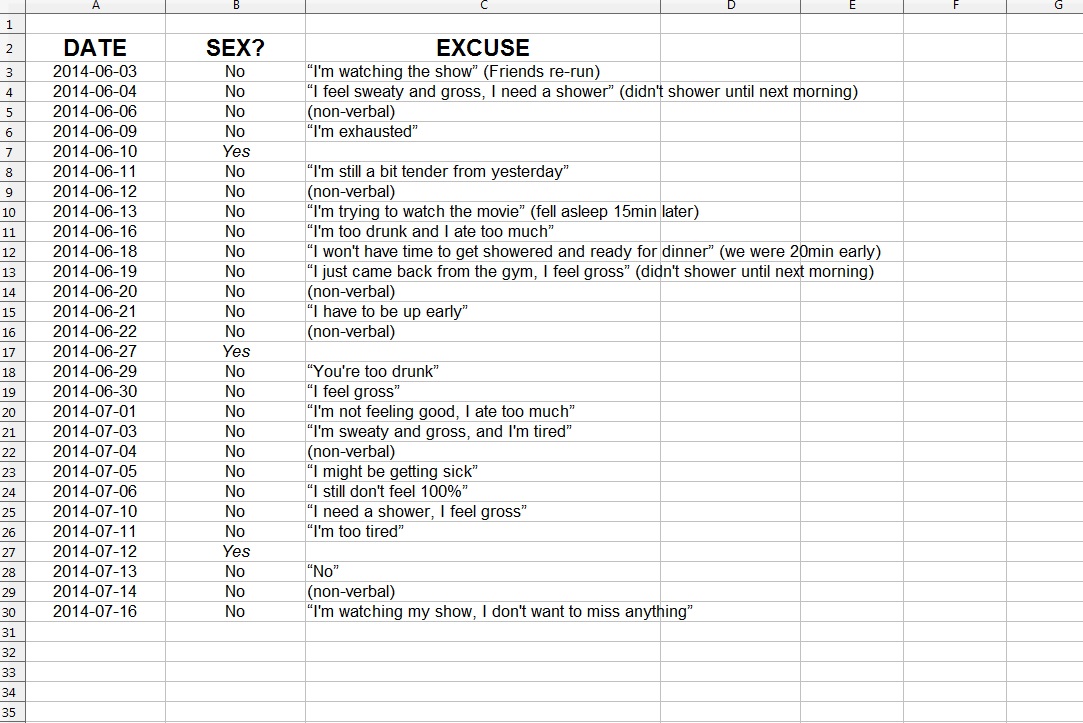
cSCdYL3


Yep, the dude created a spreadsheet that listed reasons why his wife refused him sex. Sadly, I’ve heard most of these myself–as every husband I know has. For whatever reason, the social script in America (and several euro cultures) calls for women to withold sex basically from the 3rd year of marriage onward. This behavior exists in varying degrees but seems Standard Operating Procedure for the stereotypical marital situation. Of course, stereotypes are not reality but can often be based in some sort of statistical reality. Like I said, I know a slew of guys who, while not actually doing this sort of study themselves, can attest to this manner of call and response behavior.

Because I saw it, I’ve decided that I want to start speaking out more about the things that we know to be memetic but actively avoid talking about. ‘We don’t speak about fight club.’

We don’t speak about a great deal of things that we should…

1557. My Scruffy Logic

The one thing in Luc Besson’s death rattle of a movie, Lucy, that made any sense was the idea of time providing a sense of life. Time is the measurement by which we define life—though we do it unconsciously. Think about: If we are made up of our energy, our actions, and our memories, we must have some constant by which those things exist. That is time. In particular, the passing of time allows for motion and even thought. No matter how instantaneous these things seem to be, they all occur within some quantum unit of time. Another way to look at death is as the cessation of future time. Once we are gone we can no longer perceive or inhabit time as it thrusts forward towards the eventual collapse of the universe.


Sometimes, I like to think that death is merely the end of our film and once over our consciousness continues to inhabit every moment of that film, allowing us to exist in those moments over and over again. In that sense we live in our own memories. This may be a happy or deeply unhappy existence, depending on the life one lead. Generally I feel we all experience both emotional poles throughout the course of our lives.


All of this brings me back to the question of life itself: Are we ‘alive’ and what does that mean exactly? Alan Turing developed a test decades ago that determined if something was a thinking person or an automated device. Modifications of the original Turing test are all across the ‘net as method of rooting out smart bots designed to pose as ‘people’ simulate the possible options a person would have to carry out instructions.


What separates us from those machines is a deeper level of scripting or social coding as well as a level of autonomy surrounding our code. While a computer is coded to carry out a specific set of instructions based on a quantifiable number of variables, most of us are coded to respond to more of a ‘prime directive’ on a social and biological level, and make autonomous decisions guided by that directive. Surprisingly enough this is best displayed through the interactions of teenagers in high school where the ‘prime directive’ is often as simple as gaining social recognition and status, with all of our autonomous actions carried out by the ridiculous amount of computing power in our brains working towards the directive. Not to make light of suicide, but it can be explained in the same way. The person committing suicide is often responding to a prime directive of personal happiness and is therefore reacting to a set of variables that have caused them to see the directive/goal as completely unattainable and as such to see life as untenable. What to us who still can reach our prime directive seems insane is merely a scruffy logic solution to a problem.


So, are we alive or just machines? Both, I think. We are programmed like machines from the moment of out births. We also come with a preexisting set of biological programs designed to keep us alive and reproducing. Regardless of who or what forces created us, we have since become learning machines capable of developing our own scripts and social programs for the world and changing the world to suit those scripts. There is little difference between this and where we are headed with artificial intelligence.


The one difference is that an AI knows it is a machine created by something (for the moment) greater than itself. Most humans believe we were created by something greater than ourselves, but how many are willing to admit that we are biological machines?
1556. Reflections on a Sunday Night

Rough saturday night/Sunday morning. I went to bed before midnight only to wake up after one in a cold sweat and terrified of my own mortality. This happens from time to time–especially when I find myself wondering openly about the relationship between man, animal, and computer. This latest night of terror and fear of eventual oblivion was fueled by a dark realization that we may merely be biological computers. I’m not talking about the Douglas Adams conundrum, instead I’m thinking of a more basic realization. We are largely limited by the scripts we run (be they social, biological, or otherwise). Because they are derived from biology and sociology we see ourselves as somehow being higher order beings. What if a computer developed the same level of scripting as a human. What then would separate it from us besides the fact that we programmed it? Does this then mean that faith is a mass hallucination and in the end we are merely walking programs that will eventually run their course? There’s a lot to think about in those questions, so I’ll go through what triggered my terror and then try to relate that to the above.

What happens when we die? Those of faith speak of the afterlife as a place where the spirit remains intact. I struggle mightily with the idea of ‘post-life’ because I view life as a collection of experiences. I do not believe we can take that with us when we depart. I think the idea of a soul is real–I consider it to be the activation energy that initially charges all life. I don’t think that energy is capable of holding together that which makes us individuals. In fact, I believe we are reincarnated as other forms–perhaps even becoming people again. Those new people are invested with new social scripts and biological imperatives that come to define them as individuals the way ours come to define us. In other words, they are not us. They are a part of us and likely posses the same core soul but the memories dissipate. My memories are me and when I die I cannot create anymore. I essentially enter a halting state–like a computer shut down… Only a computer is built on non biological chips and can be started back up again.

We are far more fragile.

There is more to be said here, but I will continue this line of thought tomorrow.


Some Thoughts:

  1. My Iphone be dead, yo. If folks are trying to reach me, I apologize and I hope to fix the problem tomorrow.


1555. T-U-R-T-L-E Power!

Suddenly I write a movie blog.

I write about what strikes me at the time, and at this time I’m struck by the comic movies this summer. I thrilled to Guardians of the Galaxy and today I sat back and grinned to a surprisingly nostalgic Teenage Mutant Ninja Turtles film. Look, the turtles aren’t high art, so if you’re looking for deep dialogue and plot twists, you’re out of luck. If you want to have fun and catch some smart one-liners, you are headed to the right film.

Turtles is not entirely an origin story. It plays more like an episodic that introduces (and provides a brief background summary to) the Shredder. The film starts by explaining (and partially reinventing) the origin of the turtles. The film quickly switches focus to a reimagined April O’Neill, sharing her story and origins. Keeping it real, she’s only there to be pretty and the filmography works to ensure that purpose is met. What stood out to me was not her, was not Shredder, but was Master Splinter and the ability of the writers to quietly pay homage to turtle movies and shows of the past. There was even a thinly veiled reference (and possible hint of future inclusion?!?) to Usagi Yojimbo, Samurai Rabbit.

I’m slowly moving back into watching deep literary stuff and reading the same, but in the meanwhile it is good to have some frivolous joy every once in a while.

1554. How Lucy exposed Luc

Watching the Wu tang clan give an interview the other night I was struck by the comparison one rapper drew between rapping and being an athlete. He talked about growth, mindset, the ebbs and flows of business, but he neglected to talk about the athletes dilemma: eventually you get old, warn out, and replaced. From the opening scenes of Lucy I recognized Luc Besson is done and there is nothing more he can make of value.

For those unfamiliar with his work, Luc Besson brought us Leon The Professional, the film that launched Natalie Portman’s career (IMHO). He is also known for Taken, The Fifth Element, Arthur and the Invisibles, La Femme Nikita (including both TV series), The Messenger, District B13, even the Transporter (the first one was legit). What you may not know is that he is also the writer/creator of Taxi Brooklyn, which is further proof of his decline. Lucy gives us proof enough. This longer than needed, highly contrived, mess of  a movie is held together by the powerful narration provided by Morgan Freeman. Had he been the entire movie, it may have been a better experience. At points throughout you could see Scarlett Johansson struggling to make more of her character than what is on paper. I mean he straight up didn’t even try to write a character of worth. That’s the problem: He no longer has it within himself to create good, new, content. He is forced to dredge up and recycle old ideas with the hopes on riding out those once important characters like a literary pension. Not convinced? Here is proof: Taxi Brooklyn is a freshened up version of the movie he made in 1998. Still not convinced? Taken 3 is in post production and The Transporter 6 has already been announced.

We get old and, at some point, we lose the fire and or ability to produce good work. Luc is there. Lucy is proof of that. I’m glad to have seen the film. It served as a funeral of sorts for a career I’ve followed my entire movie-watching life. I’m sorry Luc Besson is gone, but seeing that makes it easier to forget that he is still around.

1553. On Teaching Writing and Developing Theme

I hated English class. Even as a 9 yr old I thought, “Seriously, we gotta do the writing again?” This did not improve in the least through high school. By the time I reached college, my disengagement with English class resembled the relationship between the two Koreas. It had everything to do with a difference in expectations and goals. I wanted to go to play and the teachers wanted to talk to me about a language I felt I already knew and writing I was convinced I’d never need in the ‘real world’. Even as a teacher I’ve seen that strange dichotomy extended to my colleagues. Often we talk about ‘content’ courses such as Science or Math or Sociology where there is a long list of material that needs to be delivered. English is not treated as a ‘content’ course. Instead it is seen as some amorphous other where, in the absence of being defined as a ‘content’ course, it is by nature being defined as having no content whatsoever. Of course, English does have content and purpose. I didn’t figure it out myself until the first day I taught a class.

I remember that day clearly: I was shoved headlong into a classroom with a bunch of first year honors students, no script, and no idea what to tell them. So, I asked them for help. With that I learned a lot about how they felt, how I felt, and what was needed in order to create an environment that benefited us all. That is very important. I recognize that as the teacher I have to be there, but I believe that I have to want to be there in order to be effective for my students. The way I do that is by developing a theme for the class that makes it more relatable and valuable to the students. They are writing and learning about writing but in a way that allows them to develop the habit of writing, learn the process of writing, and take their writing wit them to be used later in their academic or professional lives.

The one thing I’ve figured out about life is that people have to be on the same page and heading in the same direction to work. If you’re not there then nothing else is going to matter. It is difficult to engage with a teacher if you feel they are only going to waste your time. It is equally difficult to engage with a student knowing they’re forced to be there and have no intention of participating willingly. Grades play a damaging role in this equation, because they reinforce the notions of control and limit the value of the experience. Grades become all the student wants out of the experience when learning should be the primary endgame.